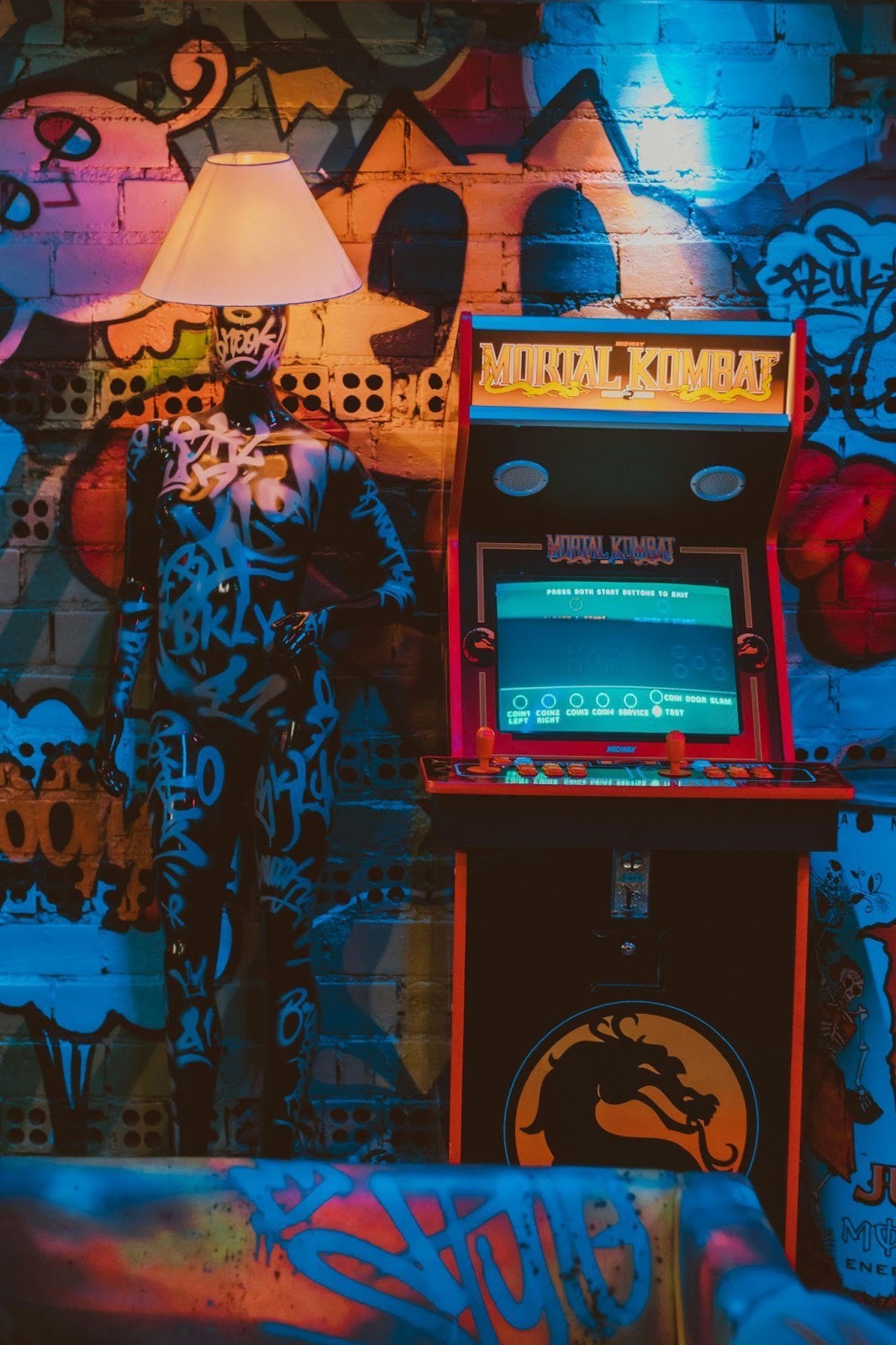
When a game world pulls you in instantly, it isn’t luck that its design is in motion. The curve of a landscape nudges you forward. A character’s silhouette tells you who they are before they speak. A level teaches you how to play without saying a word. None of this happens by accident.
Modern games succeed because game artists and game designers work in lockstep, shaping how players feel, think, and act. To understand modern game development, you need to look behind the screen where creativity meets structure and imagination becomes an interactive experience.
Game Art vs. Game Design: The Architect and the Decorator
While often used interchangeably by outsiders, the game artists and game designer’s roles represent two different sides of the brain. Think of game design as the blueprints and structural integrity of a house, while game art is the texture of the walls, the lighting in the rooms, and the view from the window.
| Feature | Game Art | Game Design |
| Primary Goal | Visual Immersion & Aesthetic | Logic, Systems, & Engagement |
| Core Tasks | 3D Modeling, Texturing, VFX | Mechanics, Level Design, Balancing |
| Key Questions | Does this look real? Is it readable? | Is this fun? Is it too hard? |
| Success Metric | Visual “Presence” & Style | Player Flow & Retention |
The Visual Vanguard: The Game Artist’s Role
A game artist acts as a visual psychologist. They don’t just “draw”; they build assets that tell a story without using words. In modern game development, artists use Physically Based Rendering (PBR) to define how light interacts with surfaces, deciding if a knight’s armor looks like polished steel or rusted iron.
- Environmental Storytelling: Artists place a single knocked-over chair in a pristine room to signal a struggle, guiding the player’s subconscious.
- Visual Hierarchy: They use color and saturation to lead your eyes toward a mission objective.
- Asset Optimization: Artists must ensure a high-fidelity character model doesn’t crash the engine, balancing beauty with technical performance.
The Master of Mechanics: The Game Designer’s Role
The game designer builds the “why” behind every “what.” They define the rules of the world. If an artist creates a beautiful sword, the designer decides how much damage it deals, how fast it swings, and what happens when it breaks.
A designer’s work focuses on “The Loop,” the core cycle of action and reward that keeps you playing at 3:00 AM. They study player behavior to ensure that the difficulty curve feels challenging but never unfair. From narrative branching to economy balancing in live-service titles, the designer scripts the soul of the experience.
Game Art vs Game Design: Complementary Languages
The distinction between game art and game design often confuses outsiders because excellent games blur these boundaries seamlessly. Artists and designers speak different creative languages, yet both disciplines must ultimately serve the same master: player experience.
Key Distinctions:
Game art asks: “How do we make this world visually coherent, emotionally resonant, and technically feasible?” It operates through aesthetics, visual communication, and technical execution. Artists translate abstract concepts into concrete visuals that players can see, understand, and emotionally respond to.
Game design asks: “How do we make this interaction meaningful, this challenge satisfying, and this progression rewarding?” It operates through systems, player psychology, and iterative testing. Designers translate player desires into mechanical systems that create specific emotional experiences through interaction.
The magic happens at the intersection. A beautifully modeled weapon means nothing if it feels unsatisfying to use. Perfectly balanced combat mechanics fall flat if they lack visual impact. The best modern game development treats art and design as inseparable, each discipline informing and elevating the other.
Hades exemplifies this synergy perfectly. Supergiant Games’ artists created a distinctive art style that makes every character instantly recognizable, even at gameplay distance crucial for fast-paced combat.
The designers crafted a roguelike progression system in which death advances the narrative. Art and design collaborate: stunning character portraits reward progression, environmental art telegraphs enemy types and attack patterns, and visual effects provide split-second feedback during frantic combat. Neither discipline dominates their dance.
The Game Development Pipeline: Where Art Meets Design
Understanding the game development pipeline reveals how the game artists’ role and the game designers’ role interconnect throughout production:
Pre-Production (Concept Phase):
- Designers create gameplay prototypes, testing core mechanics
- Concept artists explore visual directions and art styles
- Both disciplines collaborate on vertical slices, proving viability
- Critical decisions about scope, style, and technical requirements lock in
Production (Build Phase):
- Environment artists construct levels from designer whiteboxes
- Character artists model assets specified in design documents
- Designers tune mechanics based on artist-created prototypes
- Technical artists bridge gaps between artistic vision and technical reality
- Constant iteration as artists and designers discover what actually works versus what sounded good in planning
Polish (Refinement Phase):
- VFX artists add visual feedback to designer-tuned gameplay
- UI/UX artists integrate information design to serve gameplay clarity
- Designers balance economies and progression based on playtesting
- Artists optimize performance without sacrificing visual quality
- Both disciplines respond to playtester feedback, adjusting their work to improve player experience
This pipeline isn’t linear it’s cyclical and collaborative. Designers might discover that a mechanic they envisioned doesn’t work with the art style that the artists developed. Artists might create an environment so compelling that designers build new gameplay specifically to showcase it. The best studios embrace this creative tension, recognizing that the conflict between artistic vision and design constraints often produces the most innovative solutions.
Your Career in the Digital Frontier
The industry is hungry for specialists. In 2026, over 3.6 billion people identified as gamers worldwide (Icon Era 2026). This massive audience demands higher fidelity and more innovative mechanics than ever before.
To bridge the gap between being a fan and a professional, you need a technical foundation that mirrors the intensity of a real studio. A one-year, intensive game art design course in Canada provides the hands-on mentorship required to master the game development pipeline. Modern studios no longer look for generalists; they look for artists and designers who have already spent a year working in a simulated production environment.
Final Thoughts: Designing the Future
The “behind the scenes” of a modern game is a chaotic, beautiful symphony of logic and aesthetics. Whether you gravitate toward the brush or the blueprint, your role is essential to the medium. As technology like AI and real-time ray tracing evolves, the human element, the ability to design for emotion, remains the most valuable asset in the room.
Read More: Acamento